How to Choose the Right Homer Translation for Students and First-Time Readers

Why Choosing a Homer Translation Is So Hard — And Why It Shouldn’t Be
If you have ever stood in a bookstore, library, or online shop staring at a shelf of Iliads and Odysseys—each promising to be the version to read—and felt quietly overwhelmed, you are not alone.
In fact, that feeling is so common that it has become one of the great, unspoken barriers to reading Homer at all.
I’ve been studying Homer since I was very young. I’ve read many translations. I’ve created one of my own. And I’ve taught Homer to junior-high students, high-schoolers, college students, and busy adults who wanted their first serious encounter with these poems—but didn’t want to feel lost, inadequate, or unintelligent in the process.
And I can tell you this with absolute confidence: When people struggle with Homer, it is almost never because they are “not smart enough.”
Yet that is precisely how many readers feel.
They open a translation. They recognize the words individually. But the sentences feel foreign. The names blur together. The action seems distant. And slowly—sometimes within a few pages—they begin to think the problem is them. So they stop reading.
That quiet moment—when a reader gives up on Homer forever because of a bad first encounter—is, to me, one of the great tragedies of literary education.
It’s especially painful because Homer himself was not an academic. He was not a scholar writing for classrooms or committees. He was a storyteller—a bard—performing for living audiences who laughed, gasped, argued, drank, and listened. His goal was not for someone to master an archaic language. His goal was experience.
This guide is written for first encounters, not lifelong specialization.
By “first-time readers,” I mean:
junior-high and high-school students encountering epic poetry for the first time
college students reading Homer outside (or even inside) a classics department
homeschooling families
adult readers returning to Homer after years—or decades—away
This is not a guide to choosing the most academically prestigious translation.It is a guide to choosing the right translation to begin with—so that readers actually finish the poem, enjoy it, and want to come back.
Because once that happens, everything else becomes possible.
Why “What Is the Best Translation of Homer?” Is Actually a Homeric Question
One of the most common questions people ask is:
What is the best translation of Homer?
You’ll often hear that this is the wrong question. That it’s naïve, subjective, or misguided. I disagree.
In fact, I think it is a perfectly Homeric question—even if the people asking it don’t yet realize why.
Homer gives us the earliest depictions of athletic contests in Western literature—the ancestors of the Olympic Games. His world is obsessed with excellence. Who is the best runner? The best archer? The strongest warrior? The greatest tactician? The most cunning speaker?
The Greeks did not shy away from ranking greatness. They lived inside that question.
But Homer also shows us how complicated the idea of “the best” really is.
Achilles may be the greatest warrior in single combat. Ajax may be the one everyone wants beside them in battle. Odysseus may lack brute strength but possess strategic genius. So who is best?
The question itself forces reflection. It invites comparison. It leads naturally to philosophy.
When modern readers ask which translation of Homer is “best,” they are already thinking in a Homeric way—trying to identify excellence, purpose, and function. Today, the problem isn’t the question; the problem is how the question is answered.
A translation is not a ranking. It is a tool. And tools are only “best” relative to what you are trying to do.
A scalpel is not better than a hammer. A textbook is not better than a novel. And a scholarly translation is not better than a storytelling translation—unless your goal requires it.
For teachers especially, this distinction matters. Students don’t fail to read Homer because Homer is “too hard.” They fail to read Homer because they are handed the wrong tool for their stage of reading.
The Two Common Pieces of Advice — And Why Both Fail Beginners
When people go searching for guidance on which Homer translation to read, they are usually given one of two types of advice. Both are well-intentioned. Both are widespread. And both routinely fail first-time readers.
A. The Subjective “Taste Test” Approach (Why It’s Misleading)
One popular approach encourages readers to sample a passage from several translations and simply choose the one they “like” the most.
This is often framed as a taste test. Read a few versions. Rate them on a scale of 1-10 as you go. Go with your preference.
On the surface, this sounds reasonable—even democratic. But it is deeply misleading, especially for beginners.
Here’s why.
First, momentary preference does not predict long-term readability. A translation that sounds good in a short excerpt may become exhausting, confusing, or emotionally flat over hundreds of pages.
Second, performance bias matters more than people realize. If a person reads these passages to you (as in the above example) that person reading the passage may have more energy in one take than another. The listener may be more alert. The passage itself may be easier. None of this has anything to do with how the translation actually functions as a reading experience.
Third—and this is the most important point—you may prefer a later translation simply because you finally understand the passage by then.
If you hear the same scene five times in a row, the fifth version often feels clearer—not because it’s better, but because you now know what’s happening. The clarity comes from repetition, not translation quality.
Imagine a nutritionist saying: “Taste every possible food. Rank them by how much you like them. Then commit to whichever one tastes best as your diet for the next year.”
That would be absurd. Taste is real—but it is not a plan.
First-time readers don’t need a taste test. They need guidance toward a translation that is designed to teach them how to read Homer in the first place.
B. The Authoritative / Scholarly Recommendation Approach
The second common approach goes in the opposite direction.
Instead of subjectivity, it offers authority.
You are told to read this translation because it is the most respected. Because it comes from a major academic press. Because it is praised by scholars. Because it represents the latest or most faithful research.
There is nothing wrong with scholarship. In fact, without scholars, translators like me would not be able to do our work at all. Scholarly research is indispensable.
But scholarly usefulness is not the same thing as reader accessibility.
Most scholarly translations are created with a classroom—or an academic reader—in mind. They preserve complexity. They retain unfamiliar structures. They assume a level of patience, context, and support that most first-time readers simply do not have.
The result is that intelligent, curious readers—often including junior-high, high-school, and even college students—are handed translations that are not designed for their needs and then quietly blamed when they struggle.
Prestige does not equal approachability.Authority does not equal hospitality.
And when the wrong translation is chosen at the wrong time, the reader doesn’t just struggle—they leave.
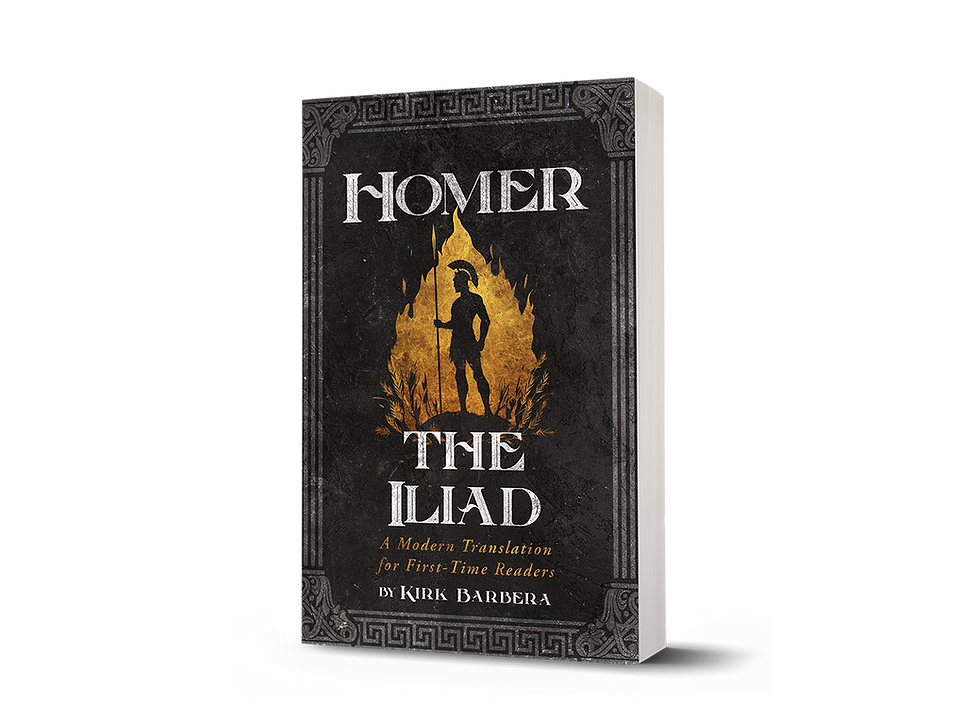
My Translation of The Iliad
I will be giving a translation recommendation for first timers other than my own translation. But I do hope you will try my translation which builds upon an earlier inspirational translation that changed my life.
Why Modern Readers Struggle with Homer (And Why It’s Not Their Fault)
One of the most damaging myths about Homer is that he is “naturally hard,” and that struggling with him is a sign of intellectual weakness or insufficient preparation.
That simply isn’t true.
Modern readers struggle with Homer for structural reasons, not personal ones. Once teachers and readers understand why the struggle happens, the problem becomes solvable.
A. Homer Was Written for an Audience Who Already Knew the Story
Homer’s poems emerged from an oral culture, not a print culture.
When Homer performed The Iliad or The Odyssey, he was speaking to an audience that already knew the Trojan War. They knew who Achilles was. They knew who Agamemnon was. They knew how the war began, how it would end, who lived and who died, and even why it mattered.
In other words, Homer’s original audience did not need exposition.
Imagine creating a brand-new Spider-Man story for a group of American teenagers. You would not need to explain who Spider-Man is, why he has powers, or what motivates him. You could begin in the middle of the action because the cultural groundwork already exists.
Homer does exactly this—but on a much larger scale.
By the eighth century BC, the Trojan War functioned as a shared mythic history. These stories were canonical, even religious. Listeners did not need constant reminders of who was who or why events mattered. The poet could rely on mythic shorthand.
Modern readers, however, do not live inside that world.
When students encounter Homer today—especially in junior high, high school, or early college—they are being asked to decode:
unfamiliar myths
unfamiliar social values
unfamiliar poetic conventions
unfamiliar narrative pacing
Without scaffolding, that is an unreasonable expectation.
B. Names, Patronymics, and Cognitive Overload
One of the fastest ways to lose a first-time reader of Homer is through name overload.
Homeric characters are frequently identified not by a single stable name, but by:
patronymics (“son of Atreus”)
titles
epithets
tribal or regional identifiers
This works beautifully in an oral culture where listeners already know the cast. But for modern readers, it can be devastating.
Consider this problem: A translation refers to “the son of Atreus.”But there are two sons of Atreus on the battlefield: Agamemnon and Menelaus.
Unless the reader already knows this—and remembers it in the moment—the narrative stalls. Instead of following the action, the reader pauses, rereads, flips pages, or simply gives up.
Multiply this by hundreds of names, tribes, and titles, and the result is cognitive overload.
Narrative momentum collapses not because the story is boring, but because the reader is constantly trying to decode who is being talked about.
For teachers, this is a crucial insight: confusion here is not a failure of attention or effort. It is a failure of translation strategy.
C. Syntax, Diction, and the False Difficulty of “Formal English”
Another major obstacle is what I call false difficulty.
Many students (and adults) can understand the individual words in a Homer translation—but not the relationships between those words. The syntax feels alien. The sentence structure feels twisted. The emotional through-line disappears.
This is especially dangerous because it creates the illusion of understanding.
Readers think: I know these words. Why don’t I know what’s happening?
At that moment, many shut down emotionally. Not because they dislike the story, but because the experience has become discouraging.
This is why saying “it’s just formal English” is misleading.
What’s difficult isn’t the vocabulary alone—it’s the way the language is doing its work. When translations preserve syntactic patterns that no longer function naturally in modern English, they raise the barrier to entry without increasing understanding.
For first-time readers, clarity is not a luxury. It is the gateway.
Homer Is a Storyteller First — Not a Relic
This brings us to the heart of the issue.
Homer is often treated as a literary monument—something to be preserved behind glass, approached with reverence, and handled only by specialists.
But Homer himself was none of those things.
A. Homer as Bard, Performer, and Audience-Watcher
I often think about the great playwright Henrik Ibsen, who was known for doing something unusual: he would attend performances of his own plays and watch the audience instead of the stage.
He wanted to know:
when they leaned forward
when they laughed
when they grew restless
when they felt shock or recognition
That is the mark of a storyteller.
Homer was far closer to this model than to that of a lecturer or academic. He was a bard, likely performing in public spaces—festivals, gatherings, places where attention had to be earned and held.
People were not sitting silently with notebooks.
They were listening, reacting, drinking, interrupting, and responding emotionally.
Homer’s job was not to preserve a text. It was to activate an audience.
B. What Storytellers Optimize For (Then and Now)
Storytellers—whether ancient bards or modern filmmakers—optimize for different things than scholars.
They care about:
emotional clarity
narrative momentum
images that stick
scenes that land
They care less about perfect preservation and more about felt experience.
This does not mean they are careless. It means they are selective. They choose what to emphasize, what to clarify, and what to adapt so that the story actually lives in the minds of their audience.
When translations ignore this—and treat Homer exclusively as a relic—they may preserve information, but they often lose engagement.
And without engagement, there is no first encounter worth having.
Two Fundamental Translation Philosophies: Monument Homer vs Storyteller Homer
At this point, we can name the real divide that shapes English translations of Homer.
It is not poetic vs literal.It is not easy vs hard.It is not old vs new.
It is this:
Do you treat Homer primarily as a monument—or as a storyteller?
A. Monument Homer (Source-Oriented Translation)
The “Monument Homer” approach treats the poems as cultural artifacts to be preserved.
Its priorities include:
fidelity to the source language
retention of patronymics, titles, and naming conventions
scholarly apparatus (notes, commentary, contextual density)
classroom usefulness
This approach is legitimate. It is valuable. And it is indispensable for advanced study.
But it absolutely should not be a person's first encounter with a great literary work.
Its center of gravity is the source language and scholarly precision—not the emotional experience of a modern reader encountering Homer for the first time.
B. Storyteller Homer (Audience-Oriented Translation)
The “Storyteller Homer” approach begins elsewhere.
Its priorities include:
clarity in modern English
narrative scaffolding
emotional continuity
helping readers stay with the story
This approach accepts that Homer is foreign—but refuses to make him unnecessarily inaccessible.
It asks: What does this reader need right now to experience this story as a living thing?
For first-time readers—especially junior-high, high-school, and many college students—this approach is not a simplification. It is an invitation.
And once that invitation is accepted, everything else can follow.
The Homer Translation Matrix (A Better Framework)
At this point, you can probably feel the problem with most translation advice online: It keeps trying to rank translations using categories that feel helpful at first… but collapse the moment you ask what they actually mean.
So I built a framework—partly for my own teaching, partly for my own sanity—that I call the Homer Translation Matrix.

This matrix is not meant to “prove” that one translator is superior to another. It’s meant to do something more useful: It helps teachers and first-time readers understand the intentions behind different translations—so they can choose the right tool for the right moment.
A. Why “Approachable vs Challenging” Are Bad Categories
You might have seen charts like this one from the Winnow channel on Youtube

They look scientific. They feel authoritative. They’re often delivered with a confident tone.
And they’re misleading.
1) “Approachable” vs “Challenging” Is Deeply Subjective
What feels approachable to one reader can feel impossible to another.
This isn’t theoretical. We can demonstrate it historically.
John Keats wrote one of the most famous sonnets in English—“On First Looking into Chapman’s Homer”—because Chapman felt electrifying to him. In Keats’s experience, Chapman unlocked Homer in a way that other translations had not. But on many modern charts, Chapman is labeled “challenging” or “difficult” simply because he’s old. The categories flatten the real question: Challenging for whom? For what purpose? At what stage of reading?
On First Looking into Chapman's Homer
By John Keats
Much have I travell'd in the realms of gold,
And many goodly states and kingdoms seen;
Round many western islands have I been
Which bards in fealty to Apollo hold.
Oft of one wide expanse had I been told
That deep-brow'd Homer ruled as his demesne;
Yet did I never breathe its pure serene
Till I heard Chapman speak out loud and bold:
Then felt I like some watcher of the skies
When a new planet swims into his ken;
Or like stout Cortez when with eagle eyes
He star'd at the Pacific—and all his men
Look'd at each other with a wild surmise—
Silent, upon a peak in Darien.
2) “Poetic” vs “Literal” Is a False Binary
No translation is purely poetic or purely literal.
Every translator makes choices:
what to clarify
what to compress
what to keep foreign
what to naturalize in English
Even the most “literal” translation is an interpretation. And even the most “poetic” translation is tethered to the Greek text.
So the binary creates a false confidence: it suggests that you can “pick your preference” and be done.
But beginners don’t need preference. They need orientation.
3) These Charts Produce Misleading Outcomes for Beginners
The biggest danger is practical:
A first-time reader sees a chart, chooses a translation labeled “authoritative” or “best,” struggles, and concludes:
Homer isn’t for me.
That outcome is not merely unfortunate. It’s avoidable.
And it happens because the categories are wrong.
B. The Two Axes That Actually Matter
The Homer Translation Matrix uses two axes that reflect what translations are actually doing.
Axis 1: Monument Homer ↕ Storyteller Homer
This is the vertical axis, and it’s the heart of the framework.
Monument Homer translations treat the poem like a cultural artifact to be preserved:
heavy emphasis on the source language
greater tolerance for foreignness and density
more titles, patronymics, and naming conventions
often designed (consciously or unconsciously) for classroom study
Storyteller Homer translations treat the poem like a living performance:
heavy emphasis on the target audience (modern English readers)
clarity prioritized over ritual fidelity
scaffolding, summaries, and orientation devices
designed to keep narrative momentum and emotional continuity
Neither approach is “good” or “bad.” The mistake is using Monument Homer as the default for beginners.
Axis 2: Homer for the Ear ↔ Homer for the Page
This is the horizontal axis.
Some translations are built primarily to be heard—to recreate the force of oral performance.
Others are built primarily to be read silently, with the eye moving down the page.
This matters more than people realize. A translation meant for the ear may feel punchy and alive aloud but confusing on the page. A translation meant for the page may feel clean and stable but flat when spoken.
Teachers should choose with this in mind:
Are students reading silently at home?
Are you reading aloud in class?
Are you using audio (Audible, classroom listening days, etc.)?
Once you understand these axes, the landscape becomes far clearer.
Mapping Major Homer Translations Using the Matrix
Now we can do the practical work: placing major translations where they functionally belong.
This is the section teachers tend to bookmark—because it turns a vague debate into a usable map.
A. Storyteller Homer (Page-Oriented)
E.V. Rieu (Penguin Classics) — My Primary Recommendation for First-Time Readers
If you take nothing else from this essay, take this:
If you are a teacher or first-time reader who wants the highest chance of a successful first encounter with Homer, start with E.V. Rieu.
Why?
Because Rieu is obsessed with what first-time readers actually need:
scaffolding
orientation
narrative clarity
momentum
In his editions (especially the Penguin Classics versions that helped launch Penguin Classics), he does something most “serious” translations refuse to do:
He helps you.
He gives prose summaries. He offers context. He anticipates confusion. He builds bridges into the poem for modern readers who do not already know the entire Trojan War cycle.
That is not “dumbing down” Homer. That is recreating what Homer’s original audience already had: familiarity.
Teachers: this is one of the best “first Homer” classroom tools precisely because it reduces cognitive overload and keeps students moving through the narrative.
Why scaffolding matters:A bad first experience can turn a student off forever. A good first experience creates the hunger to go deeper.
And if readers want to go deeper later, wonderful. But first: give them a door that opens.
B. Storyteller Homer (Ear-Oriented)
George Chapman — Forceful, Explosive Storytelling (with Historical Distance)
Chapman is a storyteller. His Homer is loud, forceful, compressed—sometimes wild.
He translates Homer as something meant to hit an audience.
The complication is not his intention. It’s the date.
Chapman’s English is from the early 1600s. That means modern readers may experience “difficulty” due to historical language—not because Chapman is academic or source-obsessed.
Best use cases:
advanced high school students with teacher guidance
college students in a “great books” context
readers who want to feel Homer’s intensity through older English
supplements: selected passages read aloud
If you use Chapman, use him like you’d use Shakespeare: with a sense of linguistic distance, and often with the ear engaged.
C. Middle-Ground Bridges (Where Many Readers Go Next)
Robert Fitzgerald — A Strong Bridge Translation
Fitzgerald often sits in the middle: not as scaffolding-heavy as Rieu, not as monument-driven as the most academic translators.
He can be a good next step for readers who want:
more poetic texture
more elevation
but still readability
Robert Fagles — My Favorite “More Monumental” Option
Fagles is, for many readers, the perfect second or third Homer.
If Rieu gets you into Homer, Fagles can make you feel more of the poetic architecture and weight—without becoming unreadable.
When to move here:
after a successful first encounter
when students want something “more epic” in tone
when you’re ready for greater density without losing narrative clarity
This is a common pathway for teachers:Rieu → Fagles (or Fitzgerald → Fagles)
D. Monument Homer (Page-Oriented)
Emily Wilson — Valuable, But Not a First Translation
Wilson is a serious scholar, and her goal is not primarily to create a beginner-friendly on-ramp.
Her stated aim (and you can hear it in her interviews and notes) is to recreate an equivalent experience to what a fluent Homeric reader—or even an ancient listener—might experience.
That is a noble scholarly project.
It is also, for beginners, often the wrong starting point.
Her diction choices and her emphasis on preserving many names, titles, and patronymics can raise the barrier for first-time readers who already struggle with cognitive overload.
Best use cases:
after students have read the Iliad already
when you want to compare interpretive choices
when you’re teaching translation as translation
Richmond Lattimore — High Fidelity, High Demands
Lattimore is beloved by many experienced readers precisely because of his line-by-line fidelity and his ability to retain Greek syntax patterns.
But that is not hospitality. That is discipline.
Best use cases:
advanced college
close reading courses
readers explicitly seeking near-structural proximity to Greek
Samuel Butler — Useful, Explanatory, Very Page-Oriented
Butler can be utilitarian and explanatory, and some readers find him clarifying.
But he is not designed as a modern storytelling on-ramp in the way Rieu is. He functions better as a tool once students already have basic narrative orientation.
E. Monument Homer (Ear-Oriented)
Stanley Lombardo — Performance Strengths, Limited Scaffolding
Lombardo is often praised as a translation meant to be read aloud. That is true—and it’s a strength.
But “good for the ear” doesn’t automatically mean “good for beginners.”
If the translation doesn’t also scaffold names, context, and narrative orientation, students can still get lost—even if the lines sound alive.
Best use cases:
classroom read-aloud excerpts
performance days
students who already know the plot and want a more oral feel
A Practical Path for Teachers and First-Time Readers
So what should you actually do?
Here is a path that works in the real world—especially for teachers trying to get students to finish Homer, not merely “cover” Homer.
Step 1: Start with a Retelling (for Younger Readers or True Beginners)
Retellings are not translations. They’re introductions.
For younger students—and honestly for many older beginners—retellings can provide the mythic scaffolding Homer’s original audience already had.
Goal: familiarity, not fidelity.
Step 2: Use a Storyteller Translation for the First Encounter
This is where you want the highest chance of success.
Recommendation: E.V. Rieu because he builds the reader into the poem rather than punishing them for not already belonging.
Step 3: Move to a Bridge Translation
Once students can follow the story, they often want something richer and more poetic.
This is where Fitzgerald and especially Fagles shine.
Step 4: Monument Translations (Optional, Advanced)
If students become serious, curious, or scholarly, that’s the moment to introduce Wilson, Lattimore, and other monument translations.
But treat these as what they are: advanced tools for deeper work, not default “first” versions.
Retellings vs. Translations: What’s the Difference?
At this point, it’s important to draw a clear line between retellings and translations—because both are valuable, but they serve very different purposes.
A translation begins with a specific Greek text. The translator works line by line, word by word, deciding how best to convey what is happening in the original language into English. Every choice is constrained—sometimes tightly, sometimes loosely—by the source.
A retelling, by contrast, begins with the story, not the text.
A reteller may compress, reorder, omit, or expand events. They may draw from multiple ancient sources. They may smooth over contradictions. They are not trying to give you Homer’s words. They are trying to give you Homer’s story as they understand it.
Troy vs. Homer
Take the film Troy.
It is inspired by The Iliad, but it is not The Iliad. It rearranges events, removes gods, alters characters, and reshapes motivations to tell a particular modern story. That doesn’t make it worthless—it just makes it different.
You should never confuse Troy with Homer. But Troy can still introduce people to the basic contours of the Trojan War.
Nolan’s Odyssey
The same will be true of Christopher Nolan’s upcoming Odyssey.
Whatever form that film takes, it will not be Homer’s Odyssey. It will be Nolan’s Odyssey: shaped by cinematic needs, modern pacing, and a particular artistic vision. It may be brilliant. It may be flawed. But it will be a reimagining, not a translation.
Why Retellings Matter
Retellings are often the best way to:
introduce younger readers to the mythic world
give first-time readers narrative familiarity
reduce fear and intimidation
prepare readers emotionally and conceptually for a translation
They are not shortcuts. They are on-ramps.
And in an oral culture, familiarity always came first.

A Brief Note on My Own Translation
I want to say a word about my own translation—not because this essay is about promoting it, but because transparency matters.
I place my work squarely within the Storyteller Homer tradition.
Here are the guiding rules I set for myself:
My Rules
Clarity over rigidityWhen forced to choose between strict formal constraints and clear English, I chose clarity.
Always name the characterI do not refer to someone only as “son of Atreus” or “son of Peleus.” Names anchor readers. Titles alone disorient them.
Scaffolding is not optionalEach book is introduced with prose summaries. Sections are clearly marked. Readers know what they are about to read and why it matters.
Emotional continuity mattersHomer is not a list of events. He is a sequence of emotional moments—rage, grief, loyalty, defiance, tenderness. Those moments must land.
My Goals
My goal was not to create the most academically applauded translation.
My goal was to help a 15-year-old, a busy adult, or a curious teacher experience Homer as a living storyteller—to finish the poem and want more.
Who It’s For
first-time readers
high school students
homeschoolers
adults returning to Homer
teachers who want students to stay with the story
Who It’s Not For
readers seeking maximal proximity to Greek syntax
advanced philological study
classrooms focused primarily on textual criticism
This translation is one option within the framework—not the destination, not the end of the road.
If it does its job well, it sends readers outward: to other translations, deeper study, and a lifelong relationship with Homer.
Why Everyone Should Read Homer — Even If They Never Master Him
Homer has been read, memorized, argued over, adapted, painted, staged, and retold for nearly three thousand years.
That endurance is not an accident.
In Homer, we encounter some of the deepest currents of Western thought:
the obsession with excellence
the tension between individual glory and communal duty
rebellion against authority
the cost of pride
the meaning of honor
the tragedy of rage
the longing for home
Whether you admire these values, question them, or reject them—you are shaped by them if you live in the modern West.
The heroic individual.The rebellious teenager.The suspicion of unchecked authority.The drive to be the best at something.
These are not universal human defaults. They are historically formed—and Homer is one of their great sources.
You don’t have to master Homer to benefit from him.
You don’t have to learn Greek.You don’t have to read commentaries.You don’t have to join a nine-month seminar.
But you should meet him.
Because reading Homer is, in a quiet but profound way, a way of learning something about yourself.
Final Encouragement: Homer Is for the Living
Let me end with this.
Homer is not a museum artifact.He is not a test.He is not a credential.
He is a storyteller.
You are allowed to start where you are.You are allowed to need help.You are allowed to choose clarity over prestige.
You are allowed to have a first encounter.
Homer is for the living—for students, for teachers, for readers who want to feel something true and old and human.
Everyone should read Homer. Not everyone needs to master him.
But everyone deserves a first encounter that opens the door rather than slams it shut.
If this guide helps you—or your students—take that first step, then it has done its work.


Comments