The Iliad Book 1: Rage, Honor, and the Gods

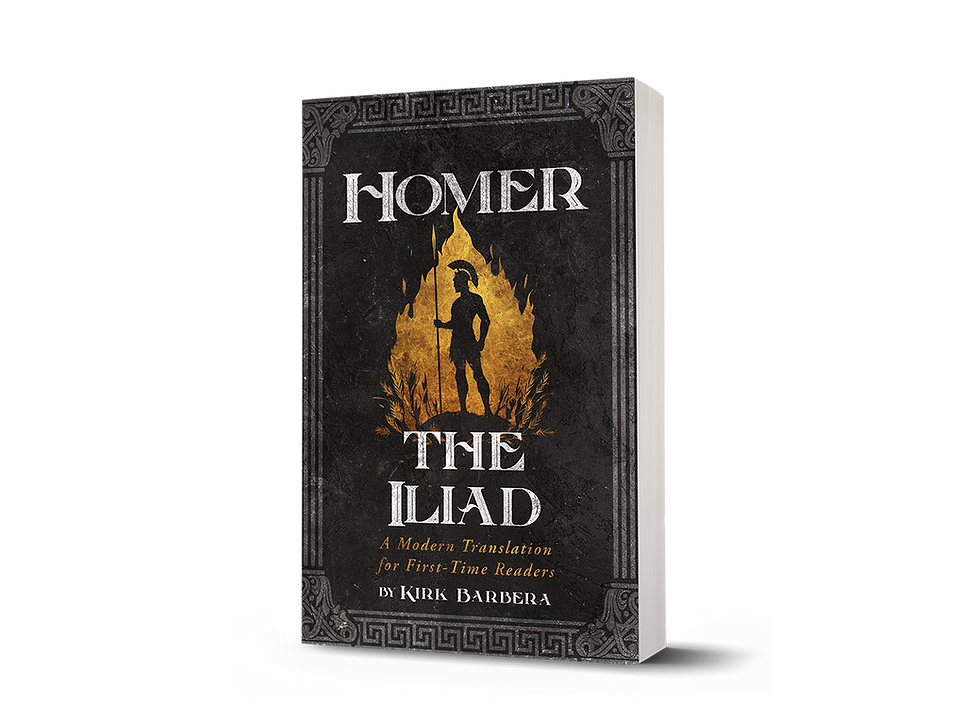
This post is your comprehensive guide to chapter 1 of Homer's The Iliad, complete with historical context, full analysis, and selected passages from my brand-new verse translation. Whether you’re here for the story, the scholarship, or you’re writing a paper, this will help you understand The Iliad like never before.
Why Start With Homer?
In the Western tradition, Homer stands at the beginning of literature. Everything that came after—tragedy, epic, novel, even film—owes something to the old bard of Greece. To understand storytelling is to engage with The Iliad. And yet for many, this work remains a distant, difficult text, buried beneath academic commentary or archaic language. That’s why I created a new translation: to bring Homer back to first-time readers in living, flowing verse.
When Homer told these stories, it was in live performance—at festivals, in taverns, to people who hadn’t studied Greek philology. They weren’t professors. They were farmers, warriors, women, slaves, citizens. And they understood every word. I want to restore that clarity. I want modern readers to pick up this story and be gripped from the first line.
What You Need to Know Before You Read
Homer drops us into the tenth year of the Trojan War. But his audience already knew the backstory, and it helps if we do too.
Long before the poem begins, Paris of Troy is asked to judge which goddess is the most beautiful: Hera, Athena, or Aphrodite. Each goddess offers him a bribe. Paris chooses Aphrodite, who promises him the most beautiful woman in the world. That woman is Helen—already married to Menelaus, king of Sparta and brother to Agamemnon. Paris abducts her, or she runs away (depending on the telling), and takes her back to Troy. This single act brings ruin on the world.
Agamemnon calls on all the kings of Greece to fulfill their oaths and join him in war against Troy. For ten years they fight across the plains of Ilion, sacking cities, capturing slaves, and laying siege to the mighty walls of Troy itself. And it is here, in this final year, that Homer begins his tale.
The Wrath of Achilles
The first word of the poem is rage. Achilles' rage. Not at Trojans, not at fate, but at his own commander. The Greeks have just sacked another city, and Agamemnon and Achilles both receive prized slave women as spoils of war. Achilles is given Briseis. Agamemnon takes Chryseis. But when Chryseis’ father—Chryses, a priest of Apollo—comes begging for her return, Agamemnon arrogantly refuses. In response, Apollo sends a plague upon the Greek army.
Through the prophet Calchas, the Greeks learn that the plague will only lift if Chryseis is returned. Agamemnon agrees, but not without humiliation. He demands compensation—namely, Briseis, Achilles’ own prize. And in that moment, Achilles' honor is insulted. His timē, his worth among the Greeks, is called into question. Achilles doesn’t just get angry. He withdraws from the war. He refuses to fight. And more importantly, he calls upon his divine mother, Thetis, to petition Zeus to punish the Greeks.
This is the true beginning of the Iliad. A quarrel between two men, yes—but also a meditation on the values of a world where honor is public and measured in material goods. Achilles doesn’t rage because he’s spoiled. He rages because, in his world, a man’s status and legacy are everything. And if honor can be stripped away by arbitrary power, then what is the point of risking your life?
The Meaning of Honor
In the ancient Greek world, honor is not an internal feeling. It’s not something you simply possess in your heart. It is given to you—by your peers, your commanders, and your community. Honor is visible. Tangible. Counted in prizes, weapons, women, treasure. If you sack a city and receive nothing, you are no one.
Achilles has risked his life over and over again. Cities fall at the tip of his spear. His name is sung in the ranks. And yet Agamemnon, the so-called high king, seizes the very symbol of Achilles’ status. And this act—this insult—is enough to rupture the Greek war effort.
The question Homer poses here is profound: what happens when the most honorable man is dishonored? What is greatness without recognition? Achilles chooses silence. He chooses withdrawal. And in doing so, he tips the balance of the war.
The Role of the Gods
We cannot understand Homer without understanding his gods. Apollo sends the plague. Athena intervenes to stop Achilles from killing Agamemnon. And Thetis, Achilles’ divine mother, kneels before Zeus to ask him to punish the Greeks.
But these are not the gods of modern religion. Homer’s gods are not all-knowing, all-seeing, or all-powerful. They are limited, embodied, and deeply human. They have emotions. They play favorites. They attend banquets. When Thetis wants Zeus’s help, she has to wait twelve days—because he’s busy.
This is theology as mythology. The gods are part of the natural world. They represent forces beyond our control, but not beyond our understanding. And when Zeus finally nods his head in agreement, Olympus shakes. The divine will becomes fate—not because it is abstract, but because it has been set into motion by very human drama.
Key Lines (From My Translation)
“Sing, Goddess, of Achilles’ deadly wrath that brought such sorrow to the Greeks in war, and sent the souls of heroes down to Hades, their bodies left unburied on the ground for hungry dogs and birds to tear apart.”
“You shameless man, so greedy and so sly... I did not come to fight the Trojan spears for my own sake... We came because of you.”
“While I live and breathe upon the earth, no man will dare lay violent hands on you—not even if you name the man himself.”
These lines frame the stakes—personal, moral, and cosmic. The wrath of Achilles is no minor grudge. It will cost countless lives.
Structure of My Translation
In my edition, I’ve broken each book into titled sections with brief summaries and subheadings. Book 1 includes:
The Wrath of Achilles
Achilles’ Oath
The Return of Chryseis
The Council of the Gods
These divisions help readers follow the action and understand each turning point. My goal is not just to present Homer’s words, but to guide readers through them—clarifying, illuminating, and inviting reflection.
Why This Still Matters
Book 1 of the Iliad is not just an ancient argument. It’s the beginning of a moral and emotional journey that will echo through every page that follows. It asks what it means to be the best. What it means to be wronged. What it means to live in a world where even gods take sides.
It is a war story, yes. But it is also a human story—of pride, pain, and the long shadow of reputation. And it begins not with bloodshed, but with insult.
If you’d like to read the full translation of Book 1, I’m offering it for free on my website: 👉 https://troubadour.studio/iliad
This is where it begins. This is the wrath of Achilles.


Comments